


LAYOUT MENU

The deep roots and fragile future of biodiversity
Species are disappearing at least 10 to 100 times more rapidly today than extinctions observed over millions of years. A biologist says the answer is reciprocity — to give to the planet and not just take.
Support sound science and smart stories
Help us make scientific knowledge accessible to all
Donate today
There are approximately 8.7 million species of plants, animals and other living beings around us that make up the biodiversity of planet Earth. Nearly 1 million of them face extinction in the coming decades, warns a 2019 assessment by IPBES, an independent body that guides governments, businesses and society in conservation and sustainable development. The current rate of extinction is at least 10 to 100 times higher than the average rate has been the past 10 million years.
Sandra Díaz, a biologist and ecologist at Argentina’s National Scientific and Technical Research Council, cochaired that global biodiversity assessment. She says that while the concept of biodiversity is well understood today, it was only in the 1980s that some scientists began to speak of biodiversity as a way to describe the variety of species identified on Earth. Over time, that approach expanded to include genetic diversity, a variety of ecosystems and the interactions between them, explains Díaz, who coauthored a 2022 article in the Annual Review of Environment and Resources exploring the evolution of the concept of biodiversity from its origins to its current use in science and public policy.
Díaz’s leadership and research on how plants respond to the environment and influence ecosystems and people’s lives have been key to placing the issue of the biodiversity crisis on the global agenda. In addition to cochairing the IPBES biodiversity assessment, she is the only Latin American to serve on the United Nations Scientific Advisory Board (since 2023) and was named one of the 100 most influential people in the world by Time magazine in 2025.
Díaz formulated the concept of functional biodiversity — the importance of the variety of functions and roles that species fulfill within an ecosystem, such as pollinating, recycling nutrients and regulating the climate. And she has championed the idea of reciprocity: that humans should not just take resources but also ensure that they give back and protect what nature provides. “Reciprocity can help conserve biodiversity because it promotes a more just and responsible relationship with all living beings,” she says.
Díaz spoke with Knowable Magazine about her career and the current biodiversity crisis. This interview has been edited for length and clarity.
Your first steps in biology were in botany. How did you go from plants to focusing on biodiversity in general?
I first decided to study biology in college in the late 1970s. At that time, ecology didn’t yet exist as a discipline at my university, but I’d always had an interest in nature in general. When I had to choose a topic for a research project during my undergraduate studies, I didn’t like the idea of killing animals during experiments. It wasn’t that I found it particularly questionable, but I felt I wouldn’t be able to do that. So I chose a topic related to plants, and that’s when I realized how fascinating they are. I also focused on the interaction between biology and the social sciences. However, at that time it was very difficult to secure grants for interdisciplinary work, something that later changed on a global scale.
How did you arrive at the concept of functional biodiversity?
At the start of my career as a scientist, I was interested in learning more about how a plant relates to other plants, nearby animals and its environment. Even during my undergraduate studies, I had learned the concept of biodiversity, which includes how many different entities there are and how they are distributed. But I wasn’t so much drawn to the classification of species as I was to the role of each one.
In a way, every plant has a sort of “profession,” and by looking at a plant’s external characteristics, one can deduce its profession. For example, in places where conditions change very quickly and the likelihood of surviving for more than a few months is very low, plants that germinate, grow and produce seeds rapidly and have a very short lifespan predominate; in other places where conditions are very predictable — where agents that destroy plant bodies are rare, but resources such as soil minerals are scarce — plants with very different bodies and lifestyles tend to thrive: They grow slowly, take a long time to reach sexual maturity, live for many years and have very resilient leaves and stems, built to last.
By observing a plant’s physical characteristics, one can infer the type of environment in which it can thrive and how herbivorous animals might react to it. That is why, in my doctoral thesis, instead of simply counting the plant species present in a grassland in the Sierras de Córdoba, a mountain range in central Argentina, I set out to measure their functional traits. I focused on observing and quantifying traits such as leaf size and texture, plant height and seed shape —features that influence how plants survive or fail to survive under different land uses, how they interact with the climate and how they affect the ecosystem — for example, through their impact on insects, livestock and soil structure and fertility. I then continued my training in this field.
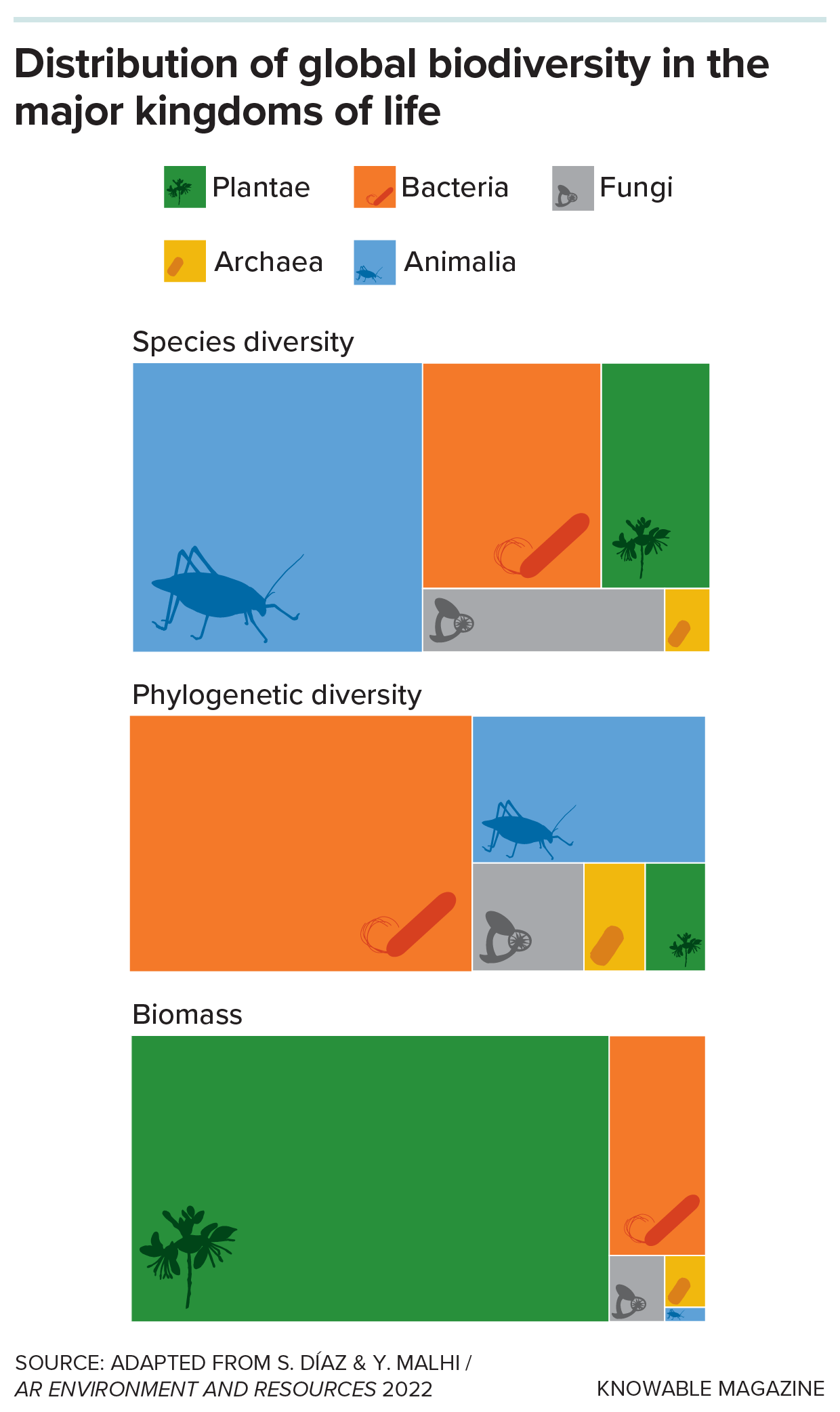
This graphic shows the distribution of global biodiversity across the major kingdoms of life based on indicators of (a) species diversity, (b) phylogenetic diversity and (c) biomass. When species diversity is considered, animals dominate. When evolutionary history is considered, bacteria predominate. When biomass is measured, plants dominate.
Was that the origin of the concept of functional biodiversity? What exactly does it mean?
Functional biodiversity is the value, variety and distribution of the functional traits that organisms possess that influence how they live, interact with others and affect the functioning of ecosystems. It is not just about counting how many species there are on the planet but about understanding how those species participate in different processes.
Functional diversity influences fundamental ecosystem processes on which human well-being depends, such as pollination, nutrient recycling, climate regulation and biological control of species that become dominant and cause imbalances in ecosystems. These processes depend on the presence of different types of organisms and their interactions, both with each other and with the environment.
To measure this type of biodiversity, we observe and classify the traits of species in a given area and estimate how diverse the community is in terms of functions. For example, in a forest, we can compare whether there are many plants with large leaves and deep roots or if other combinations predominate. In this way, we can identify which ecological functions each plant community can fulfill in a given location.
Some species with particular traits may become dominant, such as fast-growing grasses that invade fields, while others may disappear, such as certain wildflowers that require moist soil and vanish when the environment dries out. This is a change that can lead to a reduction in functional diversity and affect the health of ecosystems.
In 2001, we published a paper in which we formalized the concept of functional biodiversity and its importance for understanding how species contribute to ecosystem functioning. Since then, various research groups have incorporated the concept into their studies. Between 2010 and 2020, more than 10,000 articles related to functional biodiversity were published, according to a study published in Ecography.
How can functional biodiversity be measured?
We have recorded plant characteristics, developed protocols and systematized the information. Handbooks were created, such as the one led by my Argentine colleague Natalia Pérez Harguindeguy, to which I contributed.
Also, since 2007, many of us have built an open community repository of information on plants, which we call TRY, and it compiles information on the functional traits of plants worldwide. It has been used to conduct thousands of scientific studies.
Later, other researchers carried out similar initiatives to measure functional biodiversity in animals and created databases such as PanTHERIA, Elton Traits and FishBase. These databases contain a huge amount of data points on traits such as size, diet and life habits of animal species worldwide.
After more than 30 years of studying the planet’s biodiversity, what is its current state?
Excluding bacteria, it is estimated that there are between 8 million and 10 million eukaryotic species. Only 2 million have been described, and half of that number are insects. Meanwhile, a bit fewer than 400,000 species are vascular plants, with stems and leaves. Seven percent are fungi. Four percent are vertebrate animals such as cows or snakes. This last group is the best known.
The Intergovernmental Platform on Biodiversity and Ecosystem Services (IPBES) indicated in its 2019 report that more than 1 million species are threatened. This estimate is derived by extrapolating the percentage of known species at risk to the total estimated number of eukaryotic species.
For its part, the International Union for Conservation of Nature recently reported that more than 48,600 species are classified under some category of extinction threat, which amounts to 28 percent of the species assessed to date. These data show that global biodiversity is in clear decline. It’s not that all of them are going to go extinct tomorrow, but their future depends on us, human beings. There are groups such as corals, amphibians and sharks and rays that face a higher risk of extinction, exceeding 40 percent. Forty percent of plant species also face some form of risk, ranging from vulnerable to critically endangered. But there is one group, the cycads, that faces a risk exceeding 70 percent.
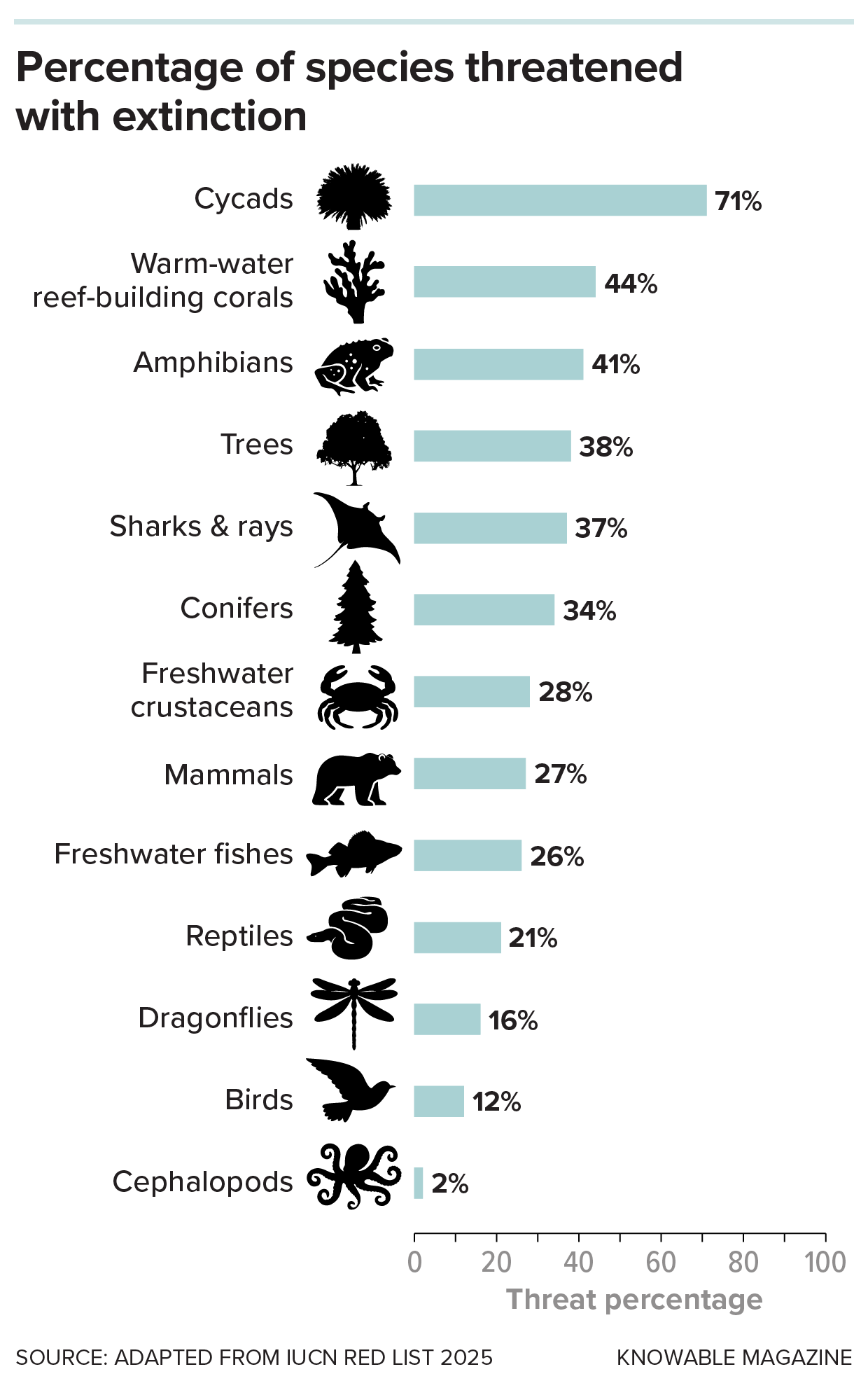
From cycads to cephalopods, data from the International Union for Conservation of Nature (IUCN) Red List, published in 2025, confirm that there are species on the brink of extinction in all assessed groups.
The rate at which species are disappearing today is at least between 10 and 100 times higher than the natural extinction rate observed over millions of years in the fossil record.
Another way to view this crisis is that ecosystems have also shrunk. For example, in my home province, Cordoba, forest cover dropped over the past century from 30 percent to 3 percent. In a more general way, genetic diversity within individual species has also declined, and this can increase vulnerability to diseases, as is the case with potato plants or south Andean deer.
What are the factors that caused the current biodiversity crisis?
A 2022 international scientific assessment identified that the main human factor behind the biodiversity crisis is changes in land and coastal use, which include agricultural expansion, urbanization and oil infrastructure. The second factor is the direct exploitation of organisms, such as hunting, fishing and logging.
Added to this are climate change, pollution and, finally, the introduction of exotic species that become invasive. The ranking of these factors may vary when specific ecosystems are taken into account.
How can we raise awareness among the public about the biodiversity crisis?
It’s a huge challenge. That’s why we now talk about the tapestry of life. It means that all living beings are interwoven into a tapestry in which we share evolutionary, ecological and symbolic connections. It sounds poetic, but it’s actually based on the latest scientific evidence. We share genes with other organisms because we all descend from a single primordial organism. There is no biological discontinuity.
We feed ourselves, clothe ourselves and live in a climate that also depends on the presence of other organisms. On a symbolic level, for example, plants, animals, ecosystems and landscapes also shape the identity of every person, every community and every country. This way of speaking — which refers to other forms of life as well as humans and the experiences we’ve shared, through coexistence, as a living tapestry — can help people connect more deeply with biodiversity.
“We must admit that organisms are not merely ‘something’ but are other beings, and from that perspective, we must coexist and cultivate humility: we are not the only ones on the planet.”
— SANDRA DÍAZ
Thinking of biodiversity as something intimately connected to one’s daily life, rather than as something out there or seen only in nature documentaries, is a very important shift in social narratives. We strive to bring about this narrative shift through public science communication, but we are aware that this, alone, is not enough. The idea is to gradually embed it in the social conversation, in the media and online platforms, in corporate settings, and at all levels of the education system.
The tapestry of life implies that we are all connected. Why did you incorporate the concept of reciprocity in one of your latest works? What is its relationship to biodiversity?
Reciprocity is a concept that we biologists learned from the social sciences and through interactions in forums with Indigenous communities. In the paper I published with the Basque scientist Unai Pascual, we approached reciprocity from a perspective that recognizes that all living beings around us are not objects but autonomous entities that act upon the world. Biodiversity and reciprocity are intertwined concepts because all living beings share the tapestry of life, where mutual links and dependencies exist. If we are to care for biodiversity, we must recognize and respect this relationship of exchange between people and nature.
Organisms have their own lives; they provide us with things, but they also perform actions that we humans sometimes dislike, such as ants in the garden or pigeons on the balcony. And, of course, the SARS-CoV-2 coronavirus pandemic is a major example of the agency of nonhuman entities — that is, the capacity to act autonomously and self-determinedly. We must admit that organisms are not merely “something” but are other beings, and from that perspective, we must coexist and cultivate humility: we are not the only ones on the planet.
Another dimension of reciprocity is mutual respect. Human beings need other organisms to live and receive benefits, but we also have obligations — such as not exterminating them, not extracting more than is needed, and not killing animals at certain stages of development, such as pregnant females or young, among others. It is like making a deal with the nonhuman neighbors on whom we depend.

The United Nations has already warned about the biodiversity crisis in the context of the climate crisis. What do you propose to address these problems?
These two crises are closely intertwined. The destruction of ecosystems exacerbates climate change. In turn, climate change impacts biodiversity. Therefore, joint actions are needed to address these crises. Fundamental changes are needed in lifestyles, production methods and energy, agricultural and trade policies to protect human health and ecosystems. But starting by considering reciprocity with nature may be key to a healthier and more just future.
Article translated by Debbie Ponchner
10.1146/knowable-051226-2
TAKE A DEEPER DIVE | Explore Related Scholarly Articles
More From